Pipeline buoyancy is a major engineering challenge in mining operations where slurry pipelines pass through waterlogged ground, tailings ponds, river crossings, and uneven terrain. Unlike municipal or marine pipelines that work in stable conditions, mining pipelines face constant changes in slurry density, flow rates, and operating cycles. These changes create buoyant forces that can cause pipelines to lift, shift, or come under high structural stress if not properly controlled.
Mining sites also bring tougher conditions such as abrasive solids, chemical exposure, temporary pipeline setups, and frequent relocation as mining progresses. Because of this, traditional pipeline support methods often do not work well. This article explains pipeline buoyancy from an engineering point of view, looking at the forces involved and the risks they create. It then focuses on mining floats as engineered buoyancy solutions that help stabilize pipelines, improve reliability, and support safe, long-term slurry transport in demanding mining environments.
Understanding Pipeline Buoyancy in Mining Environments
Pipeline buoyancy in mining slurry systems means the upward force acting on a pipeline when surrounding water or saturated ground creates more lift than the combined weight of the pipe and the material inside it. Unlike fixed pipelines, slurry pipelines face constantly changing buoyant conditions because of operational cycles and how the slurry behaves.

How buoyant forces act on slurry pipelines
- Empty pipelines experience the highest uplift forces, especially during installation or shutdown.
- Partially filled pipelines develop uneven buoyancy along their length, which increases stress at joints.
- Fully charged pipelines carrying dense slurry create more downward force, which temporarily stabilizes the pipeline.
Slurry density is rarely stable. During startup, water often flows through the system before solids, which increases pipeline buoyancy. During shutdown or flow interruption, solids may settle while water stays in the pipe, again reducing the pipe’s effective weight. Because of these changes, pipeline buoyancy is a constant and shifting challenge rather than a one-time calculation.
Buoyancy also behaves differently depending on the environment. Open water applies even pressure, saturated ground adds instability, and tailings ponds have changing water levels and moving sediment. These conditions require carefully engineered buoyancy solutions using mining floats that are designed to handle changing forces.
Why Mining Pipelines Are Especially Vulnerable to Buoyancy Forces
Mining slurry pipelines operate in conditions that increase buoyancy compared to most other industrial systems. One main reason is constantly changing slurry density. Variations in particle size, solids concentration, and moisture directly affect the weight of material inside the pipeline, which causes buoyant forces to change during normal operation.
Mining operations also involve frequent starts and stops. During shutdowns, solids settle and water separates, reducing the internal weight of the pipe and increasing uplift forces. When flow restarts, buoyancy conditions change again, placing repeated stress on the pipeline.
Many mining pipelines run over long distances and cross uneven terrain, wetlands, and water bodies. These routes create multiple zones where buoyancy behaves differently. Mining projects also often use temporary or relocatable pipeline layouts that cannot be permanently anchored. External forces such as wave action, water currents, and equipment movement interact with buoyancy forces, increasing the risk of pipeline movement when proper buoyancy solutions are not used.
Common Pipeline Buoyancy Failure Modes in Mining Operations
When pipeline buoyancy is not managed correctly, problems usually start slowly and then become more serious. Many failures happen during low-flow conditions or shutdowns, when the weight inside the pipeline drops and uplift forces become stronger.
Typical buoyancy-driven failure patterns include
- Pipeline lift or flotation when slurry density decreases or flow stops
- Joint separation and gasket damage caused by uneven uplift along the pipeline
- Excessive bending stress at unsupported spans, leading to fatigue and cracking
Progressive movement and operational impact
In ponds, rivers, and saturated tailings areas, pipelines may not fail right away. Instead, buoyancy causes gradual movement as the pipeline slowly shifts over time. Even small movement can misalign joints, strain couplings, or interfere with nearby equipment.
Uncontrolled pipeline movement creates safety risks for workers, raises the chance of leaks or spills, and often leads to unplanned downtime. These failures show why buoyancy must be handled as a full system design issue, not just a basic support problem
Traditional Buoyancy Control Methods and Their Limitations
Mining operations have used fixed methods to control pipeline buoyancy for many years. Most of these methods come from civil or marine projects and were not designed for mining conditions. While they may work in stable environments, they often fail under changing slurry and site conditions.
Commonly used control methods include
- Anchoring pipelines with concrete blocks or dead weights to resist uplift
- Trenching and burying pipelines in soil to counter buoyant forces
- Using steel restraints or rigid supports to hold pipelines in place
In active mining areas, these methods often do not perform well. Saturated or unstable ground reduces the effectiveness of trenching. Fixed anchors cannot adjust to changes in slurry density or water levels. Steel restraints focus stress on small areas instead of spreading it evenly.
Over time, these systems are hard to maintain, expensive to relocate, and limit operational flexibility. Because of this, traditional buoyancy control methods are often inefficient for modern mining projects.
Engineered Mining Floats as a Targeted Buoyancy Solution
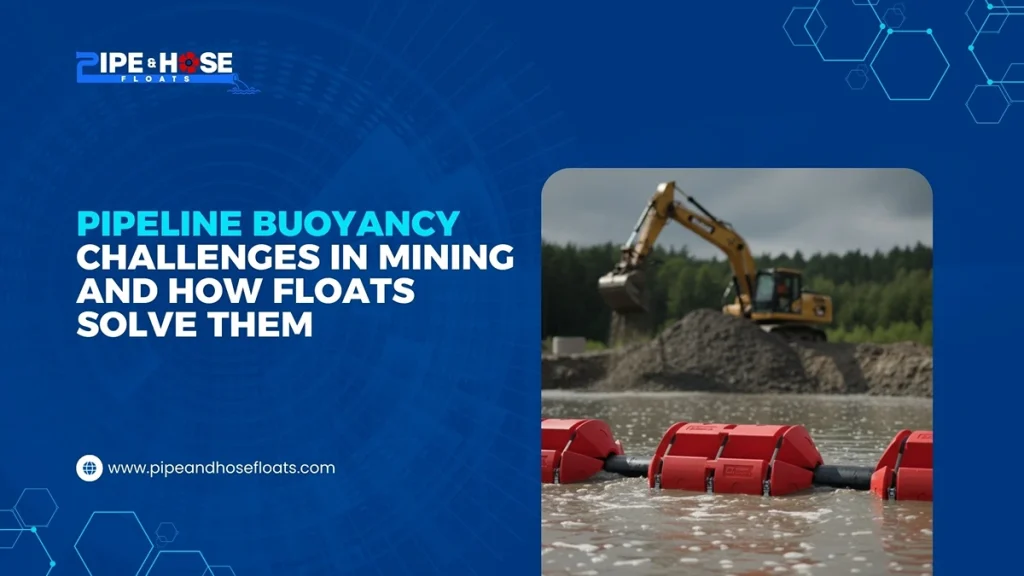
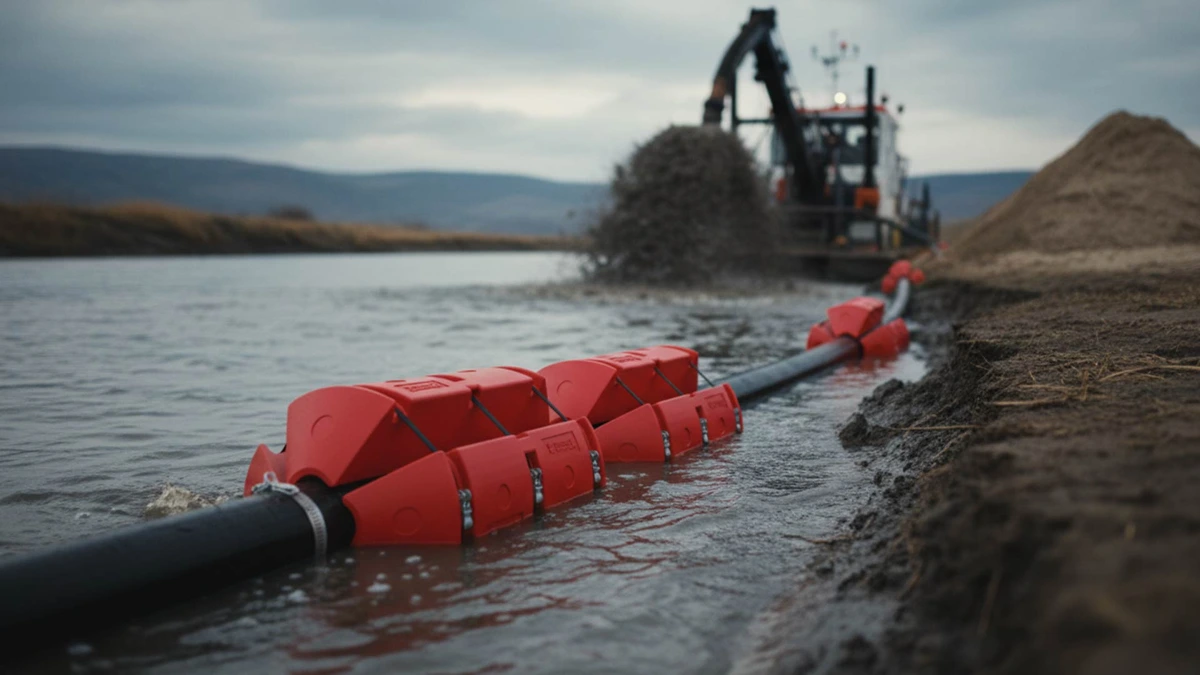
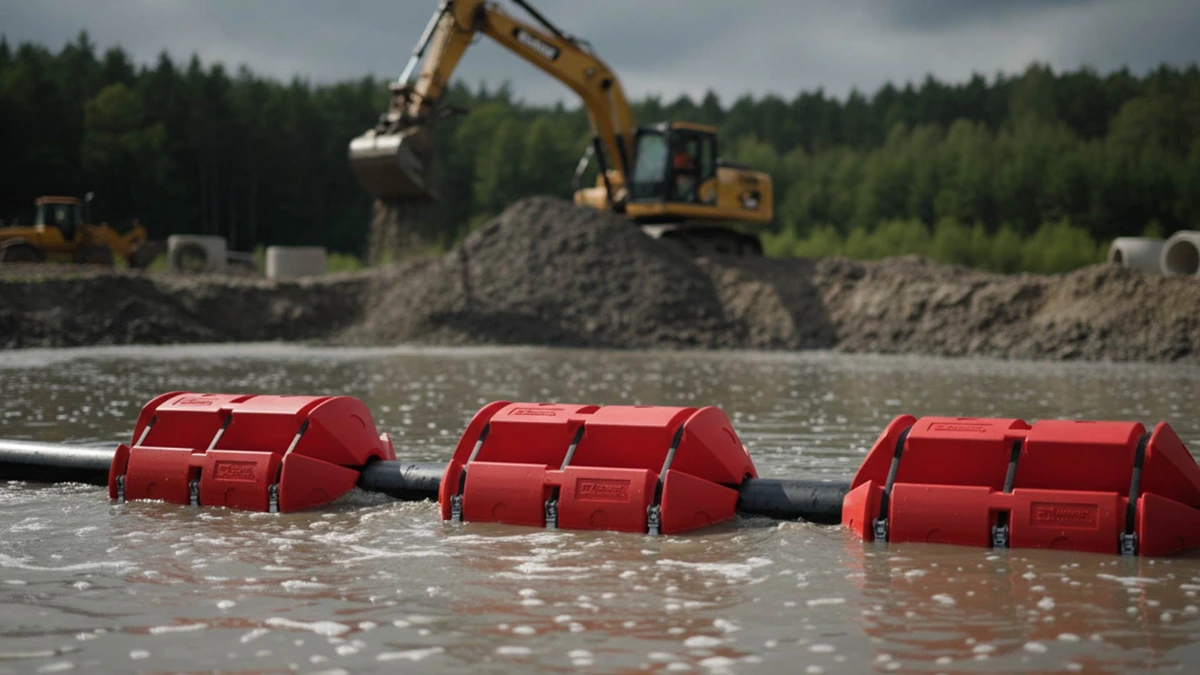
Mining floats are specially designed systems used to control pipeline buoyancy in waterlogged, unstable, or changing mining environments. Instead of trying to fight buoyant forces with fixed restraints, these systems manage and balance uplift in a controlled and predictable way.
How float-based buoyancy control works
- Floats provide calculated upward support that balances changes in pipe weight during operation.
- Buoyant forces are spread evenly along the pipeline instead of being focused at anchor points.
- The pipeline is allowed to float at a controlled level rather than lifting unpredictably.
Float systems are modular, meaning they can be adjusted easily. Float spacing and buoyancy ratings are chosen based on pipe size, wall thickness, slurry density, and surrounding water conditions. This makes it possible to design different buoyancy solutions for different pipeline sections, such as open water crossings or saturated ground.
Mining floats are flexible and scalable. They can be added, removed, or repositioned as operations change, which makes them suitable for temporary pipelines, extended discharge lines, and evolving mining conditions.
How Mining Floats Work with Slurry Pipelines
Unlike fixed anchoring systems, mining floats support slurry pipelines by spreading buoyant loads along the entire pipeline length. This reduces stress at joints and connection points, especially when operating conditions change.
When slurry flow rates or density vary, floats help keep the pipeline at a steady height. During startup or shutdown, the pipeline stays supported as its internal weight changes. This lowers the risk of sudden lifting or sagging. Instead of fully restricting movement, float-based buoyancy solutions allow controlled movement, keeping the pipeline stable and predictable.
Mining floats work with common slurry pipeline materials such as HDPE, steel, and rubber-lined pipe. Their shape supports the pipe evenly, while the float materials are selected to handle UV exposure, abrasion, and chemical contact. These features help deliver long-term performance and reliable buoyancy control in demanding mining environments.
Design Considerations When Selecting Buoyancy Solutions for Mining Pipelines
Choosing the right buoyancy solutions for mining pipelines starts with understanding net buoyancy across the full range of operating conditions. Pipe size, wall thickness, material type, and expected slurry density all affect how much uplift must be controlled during both operation and shutdown. These factors guide the selection and spacing of mining floats.
Key design elements to evaluate include
- Float spacing to ensure even load distribution along the pipeline
- Attachment methods that secure floats without restricting pipe movement
- Resistance to environmental exposure, such as UV radiation, chemicals, and abrasive solids
Mining pipelines also expand, contract, and shift as temperatures and ground conditions change. Buoyancy systems must allow controlled movement without adding stress at joints or supports. Compatibility with pumping or dredging systems is also important, especially where pipelines connect to floating equipment or mobile discharge points. Well-designed buoyancy solutions support stability while maintaining flexibility as mining conditions change.
Operational and Maintenance Advantages of Float-Based Buoyancy Control
Float-based buoyancy control fits well with the day-to-day needs of mining operations. Unlike fixed anchors or buried pipelines, floats are quick to install and require little site preparation. This makes it easier to move or adjust pipelines as mining areas change.
By spreading buoyant forces evenly, floats reduce stress on joints, couplings, and flanges. This helps pipelines last longer and lowers the risk of leaks or sudden failures. During high-water events or changes in tailings pond levels, controlled flotation improves stability and increases safety for on-site teams.
Inspection and maintenance are simpler because pipelines remain visible and accessible. There is no need for digging or removing heavy supports for routine checks. Over time, this leads to lower maintenance costs, less downtime, and better overall cost efficiency for mining projects.
Conclusion: Matching Buoyancy Solutions to Mining Reality
Pipeline buoyancy in mining is not a minor support issue or something to address later. It is a system-level engineering challenge shaped by slurry density, operating cycles, terrain, and environmental conditions. When these factors are ignored, buoyant forces can reduce pipeline stability, create safety risks, and disrupt production.
Managing pipeline buoyancy effectively requires buoyancy solutions that adjust to changing loads, water levels, and pipeline layouts instead of relying on rigid restraints. Mining floats offer a practical way to control buoyancy while allowing movement and operational flexibility.
Designing pipelines with float-based buoyancy solutions helps mining operations handle changing conditions without adding stress or maintenance work. If you are reviewing or upgrading buoyancy solutions for slurry pipelines, we work closely with mining teams to deliver engineered float systems suited to real mining environments. Learn more about adaptable buoyancy control options at https://pipeandhosefloats.com/.